How a review works
This document explains the agent pipeline end to end: how a job is claimed, how review units and specialists are spawned, what each step receives and returns, and how findings flow to the UI, PR, and (optionally) GitHub Code Scanning.
It matches the implementation in packages/agents (orchestrator, planner, runners,
discourse, judge, self-heal) and the worker entrypoint in packages/api/src/run-job.ts.
For a visual product tour (Dashboard, Gate form, session blade, Findings, Platform), see Product UI guide.
How operators experience the same pipeline in the UI:
| Pipeline stage | UI surface |
|---|---|
| Enqueue / claim | Gate or Steward Start → session row queued → running |
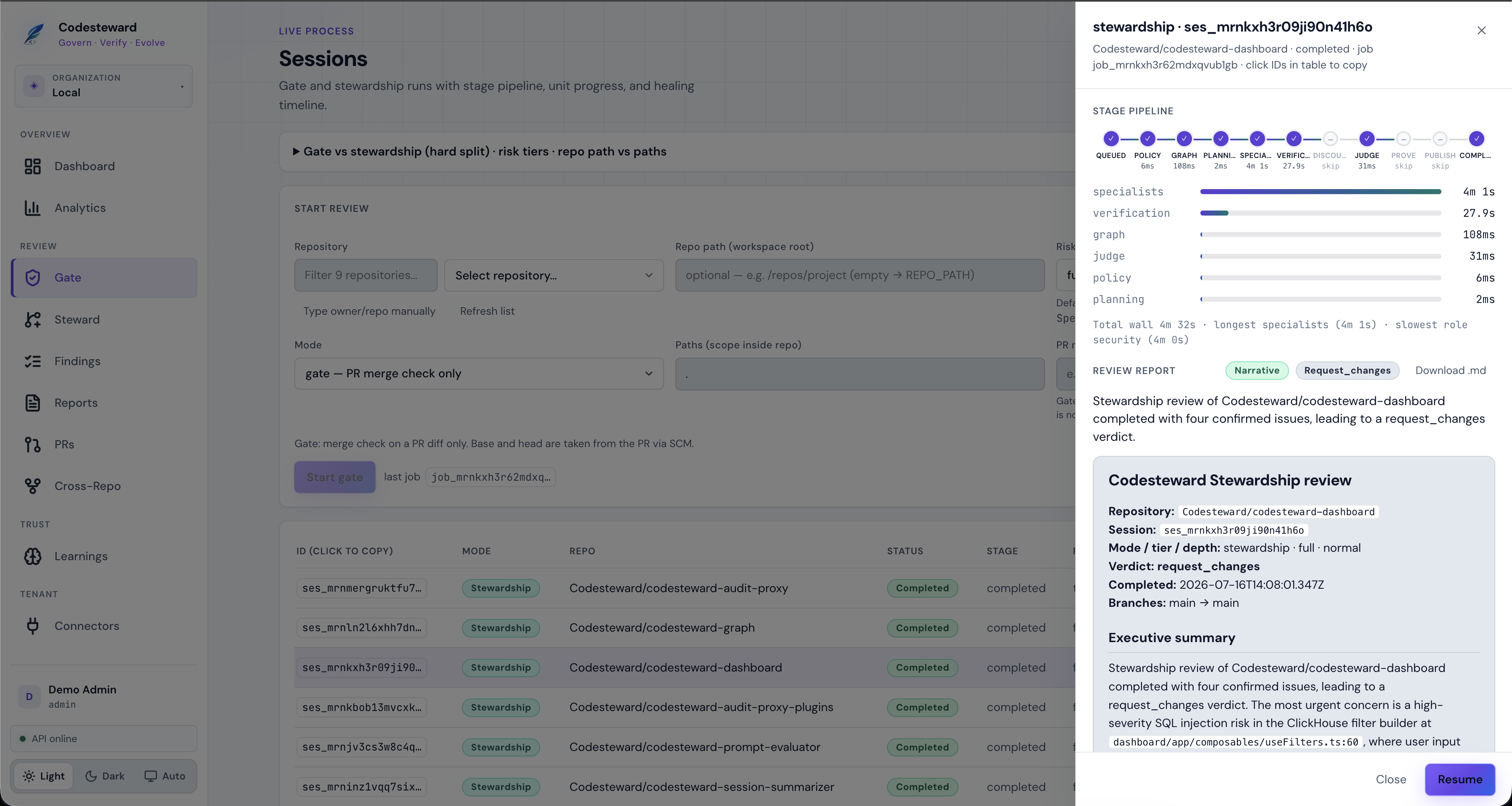
| Policy → graph → plan → specialists → … | Session blade Stage pipeline with per-stage ms |
| Findings + report | Blade Evidence, Review report, Reports page |
| Provenance | Blade Review audit + Download audit JSON |
1. Big picture
  Trigger (UI / CLI / webhook / GitHub Action)
            │
            ▼
     API enqueues a ReviewJob  ──►  Postgres job queue
            │
            ▼
     Worker claims job (SKIP LOCKED / lease)
            │
            ▼
     prepareSessionWorkspace  (clone or mount code)
            │
            ▼
     ReviewOrchestrator.run()
            │
            ├─ policy / learning
            ├─ graph (optional rebuild)
            ├─ plan units
            ├─ SAST (optional)
            ├─ specialists (per unit × roles)  ◄── concurrent
            ├─ discourse (thorough only)
            ├─ verifier
            ├─ judge + noise
            ├─ prove (optional)
            ├─ persist findings + session audit
            ├─ publish (PR comments, check run, SARIF)
            └─ workspace GC (delete clones)
There is no long multi-agent chat where specialists talk to each other in a loop. Most specialists are one LLM turn (or one DeepAgents tool loop) that returns JSON findings. Later stages read those findings as data, not as chat history.
2. From click to worker
| Step | What happens |
|---|---|
| Start review | API creates a ReviewSession + ReviewJob (mode gate or stewardship, paths, risk tier, depth, SCM metadata). |
| Queue | Job is stored in Postgres (DATABASE_URL required; FOR UPDATE SKIP LOCKED). Optional NATS/Rabbit/Pulsar only wakes workers — they are not the job SoT. After broker data loss, workers still poll Postgres; platform operators can POST /v1/platform/queue/republish (or Platform ops → Republish pending) to rehydrate broker depth for KEDA. |
| Claim | A worker process calls the queue claim API and runs runReviewJob. |
| Runtime config | applyOrgRuntimeToProcess(orgId) paints platform/org UI settings into process.env for that job (e.g. DeepAgents, SARIF publish, suggested fixes). |
| Workspace | Prefer SCM clone into {STEW_WORKSPACE_DIR}/{sessionId} when credentials exist; else mount REPO_PATH (dev). Cross-repo clones go under {sessionId}/cross/…. |
| Orchestrator | Builds graph client, model router, policy from base branch, learning prompts, then runs stages below. |
Progress is streamed as events (stage, unit, specialist_run, log, …) for the UI and session audit.
3. Session stages (orchestrator)
| Stage | Purpose |
|---|---|
| policy | Load STEWARD.md + .codesteward/rules from the base branch; seed learning prompt. |
| graph | graph_status / optional graph_rebuild for the primary (and later linked) repos. |
| planning | Split the path list into review units (file batches). |
| specialists | Run specialist roles on each unit (self-heal on failure). |
| discourse | Only if riskTier or depth is thorough: dual correctness + synthesis. |
| verification | Second-pass LLM/heuristics to keep, drop, or re-score findings. |
| judge | Dedupe, severity floor, learning suppressions, comment cap. |
| prove | Optional sandbox / LLM test generation for high-severity claims. |
| publish | Gate mode: PR review, check run, optional Code Scanning SARIF. |
| completed | Persist session audit + report; delete session clone dir (unless STEW_WORKSPACE_KEEP=1). |
Checkpoints are written under the specialists stage (and after unit completion) so a crash can resume without redoing finished units.
4. Planning: units and roles
Review units
The planner (planReviewUnits) turns the job’s path list into units:
| Mode | Batching | Typical batch size |
|---|---|---|
| Gate (PR) | Chunks of changed files | ~12 files |
| Stewardship | Group by package/top-level path, then chunk | ~20 files |
Each unit has:
id,label(e.g.gate-batch-1,packages/api)paths[]— only those files/dirsassignedRoles[]— which specialist personas run on this unitstatus— pending → running → completed | failed | skipped
Roles by risk tier
| Risk tier | Specialists on each unit |
|---|---|
trivial | generalist |
lite | generalist, rules |
full (default) | correctness, security, rules, testing |
security | correctness, security, rules, testing |
thorough | correctness, security, performance, testing, rules, requirements (+ discourse stage later) |
discourse in the role list is a marker for thorough mode; the real discourse stage runs after all units, not as a peer specialist inside each unit.
5. How specialists are “spawned”
Concurrency is unit-level, not “one giant agent swarm”:
workQueue = [unit1, unit2, unit3, …]
maxConcurrent = STEW_MAX_CONCURRENT (default 8)

while units remain:
  start up to maxConcurrent unit runners in parallel
  each unit runner (via runUnitWithHeal):
      specialistRoles = assignedRoles − {discourse}
      if runner.runUnit:
          DeepAgents → Promise.all(roles)  # roles in parallel
          Simple     → for role of roles   # roles sequential
      else:
          Promise.all(roles.map(runSpecialist))
      collect FindingCandidate[] → session candidates[]
      checkpoint unit
So with 3 units and 4 roles (full tier), you get 3 × 4 = 12 specialist LLM runs, with at most 8 units active at once. Roles inside a unit: parallel on DeepAgents runUnit, sequential on SimpleAgentRunner.
Simple runner (one turn)
SimpleAgentRunner → runUnit / runSpecialist:
- Optional graph pre-query (lexical + referential for unit paths) →
graph_contextstring - Build system + user prompts from the org prompt pack (persona + guidance + JSON contract)
- Single
model.complete({ jsonMode: true, temperature: 0.1 })per role - Parse JSON →
findings[]with optionalreasoning(+ empty-scan confidence if none) - Attach graph evidence to high-severity findings; score product confidence
- Record a SpecialistRun on the session audit (paths, tools, confidence, response hash)
Turns: typically 1 model completion per role per unit. Roles on the same unit run in parallel (Promise.all); the unit completes only when all roles finish (barrier).
DeepAgents runner (tool loop)
When STEW_USE_DEEPAGENTS=1 (default) and the deepagents package loads:
- Create a DeepAgents agent with tools:
- Graph:
graph_status,codebase_graph_query, optional rebuild/augment - Sandbox:
sandbox_read/ exec (if sandbox session opens)
- Graph:
- Invoke with the specialist system/user content
- Framework may run multiple model turns (reason → tool call → observe → …) until it produces a final answer
- Final text is peeled as JSON findings (same extract path — including
reasoning)
Turns: variable (tool-using loop). Not fixed in product code; bounded by the DeepAgents / model stack, not by a Codesteward “max 3 turns” constant.
Roles still run in parallel with a barrier before the next pipeline stage.
Each role is bounded by STEW_SPECIALIST_TIMEOUT_MS (default 8 minutes). On timeout the role soft-fails and sibling findings still merge — so one hung model/tool loop cannot freeze the session.
Rate limits: Simple runner uses ModelRouter fetchWithLlmRetry (429/5xx + Retry-After). DeepAgents does not go through that path — it uses LangChain models with maxRetries (STEW_LLM_MAX_RETRIES, default 4) and per-call timeout (STEW_LLM_REQUEST_TIMEOUT_MS, default 120s). Parallel roles × units can still trip provider quotas; lower STEW_MAX_CONCURRENT / STEW_MAX_SPECIALISTS_PER_UNIT if heartbeats stall.
If DeepAgents cannot load and STEW_REQUIRE_TOOL_AGENTS=1, the unit fails rather than silently using simple chat.
Self-heal (when a unit fails)
runUnitWithHeal can, in order:
- retry_fresh_context — same roles, refreshed context
- fallback_simple_runner — force SimpleAgentRunner
- split_unit — split paths into child units and re-queue
- skip_with_gap_note — mark skipped and emit a coverage-gap style note
Failures are appended to failureLog and checkpoints so resume can continue.
6. What a specialist receives
Each specialist call is a SpecialistContext:
| Input | Source | Typical size / notes |
|---|---|---|
| System prompt | Prompt pack persona + role guidance + locked JSON output contract | Includes severity floor, path rules, learning block |
| User prompt | Unit label, path list, packed context_text, graph_context | Context truncated (~16k chars code/diff, ~6k graph) |
| Policy | Base-branch STEWARD.md + path rules | Severity floor, nits, ignore globs |
| Learning | Org/repo/PR memories, 👎 suppressions | Injected into system as org_learning |
| Graph | Pre-fetched hits and/or live tools (DeepAgents) | Optional if GRAPH_MOCK=1 or MCP down |
| Session / unit ids | For audit + Langfuse grouping | Same sessionId across all LLM calls |
Gate packs diff context; stewardship packs file excerpts for the unit paths.
Specialists do not receive other specialists’ raw chat transcripts. They only share the same packed context for that unit (and later stages see structured findings).
7. What a specialist returns
Expected JSON (simplified):
{
  "findings": [
    {
      "title": "…",
      "body": "…",
      "path": "src/foo.ts",
      "startLine": 42,
      "endLine": 48,
      "category": "security",
      "severity": "high",
      "confidence": 0.85,
      "suggestion": "…",
      "suggestedFix": "…",
      "ruleIds": ["…"]
    }
  ],
  "emptyScanConfidence": 0.8
}
| Field | Meaning |
|---|---|
| findings[] | Candidate issues (may be empty). |
| reasoning | Structured specialist rationale (why real, what was checked, caveats) — not a multi-turn chat log. Persisted on the finding and as evidence.type = "reasoning". |
| confidence (per finding) | Model self-report → stored as modelConfidence; product confidence is re-scored from evidence. |
| emptyScanConfidence | When findings is empty: how sure the model is nothing was missed → feeds empty-scan product confidence on the specialist run. |
| suggestedFix | Only if org/platform allows STEW_SUGGESTED_CODE_FIXES and product confidence ≥ min threshold. |
Outputs become FindingCandidate[], merged into the session’s candidates list. Later stages (especially the senior verifier) read this structured list — not specialist transcripts.
8. How data flows between “agents”
There is no agent A → agent B chat pipe. Flow is dataflow:
  Unit A: correctness ──┐
  Unit A: security   ──┼──► candidates[]
  Unit A: rules      ──┤
  Unit B: …          ──┘
            │
            ▼
     [discourse?]  (thorough only)
            │  dual correctness passes + AGREE/CHALLENGE/CONNECT/SURFACE
            │  merges / boosts / drops candidates
            ▼
       verifier   (LLM/heuristic keep|drop|adjust)
            │
            ▼
       judge/noise  (dedupe, severity floor, learning suppress, comment cap)
            │
            ▼
       [prove?]   (sandbox / generated tests for some findings)
            │
            ▼
   Findings store + session.audit.specialistRuns[]
            │
            ├─► UI / reports
            ├─► PR comments + check run (gate)
            └─► GitHub Code Scanning SARIF (if enabled)
Discourse (thorough only)
- Pass A — independent correctness review (one framing/temperature)
- Pass B — second independent correctness review
- Synthesis — JSON notes:
AGREE|CHALLENGE|CONNECT|SURFACE - Merge: AGREE boosts product confidence; CHALLENGE can drop; SURFACE can introduce findings
Still not a free-form multi-turn debate between specialists—three structured LLM calls over the candidate set.
Verifier / judge
- Verifier (senior SWE): after the specialist barrier, batches candidates with
reasoning, evidence summaries, roles, confidences, and packed review context. Strong model (verifierrole). Returns keep/drop/downgrade/upgrade per index. Batches can run in parallel. - Judge: mostly deterministic noise stack — fingerprint dedupe, severity floor, 👎 memories, prior-finding awareness, comment cap. Does not re-read specialist chats.
9. Models and routing
ModelRouter picks provider/model per role (org matrix or env), e.g. stronger model for security / judge if configured.
- Simple path: OpenAI-compatible / Anthropic chat completions,
jsonModewhere supported. - DeepAgents path: LangChain chat model with the same org keys/base URL when possible.
- Optional Langfuse: all generations for a review share
sessionId= Codesteward session id.
10. Session audit (what you see in the UI)
Each specialist step appends a SpecialistRun:
| Field | Example use |
|---|---|
role, unitLabel, model, runner | Who ran, on which batch, with which model |
pathsReviewed, filesReviewed | Scope |
toolCallCount, usedGraph | Tools / graph grounding |
findingCount, findingsSummary | Titles + confidences (or “No findings” + empty-scan conf) |
avgConfidence | Mean finding confidence, or empty-scan product score |
responseSha256, responseExcerpt | Provenance without full secret-laden payload |
That ledger is how you answer: “Did security look at this package, and how sure was an empty result?”
11. Self-heal and resume
| Mechanism | Behavior |
|---|---|
| Checkpoint | After units progress: units status, candidates, strategies, failure log |
| Resume | API POST /v1/sessions/:id/resume re-enqueues; orchestrator skips completed units |
| Worker reclaim | Stale job leases reclaimed on worker boot |
| Workspace GC | On terminal status, delete {STEW_WORKSPACE_DIR}/{sessionId} unless STEW_WORKSPACE_KEEP=1 |
12. Publish surfaces (gate)
After findings are final:
- PR review — summary + capped inline comments (line-relocated)
- Check run —
codesteward/gatefor branch protection - SARIF → Code Scanning — if
STEW_PUBLISH_SARIFeffective On and GitHub supports it
Stewardship mode typically does not post a PR review; findings live in the product store/UI (and optional SARIF export via CLI).
13. Mental model (one sentence each)
| Question | Answer |
|---|---|
| Who spawns subagents? | The orchestrator, one unit at a time (up to N concurrent units). |
| What is a subagent? | A role (correctness, security, …) on that unit’s paths. |
| How many LLM turns? | Simple: 1 completion/role. DeepAgents: multi-turn tool loop until final JSON. Discourse: +2 correctness + 1 synthesis when thorough. |
| Do agents talk to each other? | No. They produce findings; later stages transform the shared list. |
| Where does context come from? | Packed diff/files + policy + learning + graph (+ tools for DeepAgents). |
| How do I debug a run? | Session audit / specialist ledger + Langfuse session id + worker logs. |
| How long did each step take? | session.audit.timings (also metadata.timings): stages, units, specialist durationMs, rollup summary for bottlenecks. |
14. Worked example: one PR gate review
This is a narrative walkthrough of a small PR so you can picture spawns, turns, and handoffs. Numbers and paths are illustrative; the shape matches production.
Setup
| Field | Example value |
|---|---|
| Trigger | GitHub Action / UI on PR #42 |
| Mode | gate |
| Risk tier | full (not thorough → no discourse) |
| Paths changed | src/auth/login.ts, src/auth/session.ts, src/api/users.ts |
| Runner | DeepAgents available (STEW_USE_DEEPAGENTS=1) |
| Concurrency | STEW_MAX_CONCURRENT=8 |
Timeline
t0  API: create session ses_abc + job job_xyz → queue
t1  Worker claims job; applyOrgRuntimeToProcess(org)
t2  Clone repo → /workspace/ses_abc (or REPO_PATH mount in dev)
t3  Orchestrator stages: policy → graph → planning → specialists → …
Stage: policy + graph + planning
- Policy loads
STEWARD.md+.codesteward/rulesfrom the base branch (not the PR head). - Graph may
graph_rebuildif stale; otherwise reuse. - Planner sees 3 files → 1 unit (under gate batch size ~12):
unit gate-batch-1
  paths: [src/auth/login.ts, src/auth/session.ts, src/api/users.ts]
  assignedRoles: [correctness, security, rules, testing]
Packed user context ≈ unified diff for those paths (gate mode), truncated if huge.
Stage: specialists (the “subagents”)
The orchestrator does not open a chat room. It calls runUnitWithHeal for gate-batch-1, which calls activeRunner.runUnit(roles, ctx).
With DeepAgents, the four roles start in parallel (same packed context, different system personas):
                    ┌─ correctness  ── LLM(+tools) ──► findings_c[]
  gate-batch-1  ────┼─ security     ── LLM(+tools) ──► findings_s[]
  (shared ctx)      ├─ rules        ── LLM(+tools) ──► findings_r[]
                    └─ testing      ── LLM(+tools) ──► findings_t[]
                              │
                              ▼
                   candidates = flat(all findings_*)
                   checkpoint(unit completed)
What each spawn gets (SpecialistContext)
| Piece | Example |
|---|---|
| System | Persona for that role + org guidance + “return JSON findings only” contract + learning suppressions |
| User | Unit: gate-batch-1 + path list + packed diff + optional pre-fetched graph snippets |
| Tools (DeepAgents only) | codebase_graph_query, graph_status, optional sandbox read/exec |
| Not included | Other roles’ prompts, other roles’ answers, prior chat history |
Simple runner only: graph is pre-queried for security/correctness (lexical + referential on basenames) and stuffed into the user message—then one model.complete(jsonMode).
Turns (DeepAgents security example)
Turn 1  model: “I need callers of parseToken”
        tool:  codebase_graph_query(referential, "parseToken")
Turn 2  model: observes graph hits; “read session.ts around line 80”
        tool:  sandbox_read / graph query …
Turn 3  model: final message → JSON { "findings": [ … ] }
- Simple runner: always 1 completion (no tool loop).
- DeepAgents: N turns until final text; N is not a fixed product constant.
- Failed DeepAgents unit can self-heal →
fallback_simple_runner(1 turn each role).
Example security response (parsed)
{
  "findings": [
    {
      "title": "Session cookie missing Secure flag",
      "body": "setCookie() in session.ts does not set Secure in production.",
      "path": "src/auth/session.ts",
      "startLine": 88,
      "severity": "high",
      "category": "security",
      "confidence": 0.9
    }
  ]
}
Product code then:
- Extracts →
FindingCandidate[] - Re-scores product confidence from evidence (model’s 0.9 becomes
modelConfidence) - Optionally strips
suggestedFixif below org min confidence - Appends a SpecialistRun row on the session audit
- Pushes into shared
candidates[]
Correctness / rules / testing do the same independently. They never read security’s JSON; the orchestrator merges lists.
After all units: dataflow stages (not chat)
Assume candidates now has 5 items (1 security, 2 correctness, 1 rules, 1 testing).
| Stage | LLM turns (typical) | Input | Output |
|---|---|---|---|
| Discourse | skipped (tier ≠ thorough) | — | — |
| Verifier | ~1 batch pass | candidates[] | keep / drop / adjust |
| Judge + noise | 0–1 (mostly code) | verified list | deduped, severity floor, comment cap |
| Prove | optional | high-severity subset | pass/fail evidence |
| Publish | 0 | final findings | PR review, check run, optional SARIF |
If tier had been thorough, between specialists and verifier:
Pass A  correctness (framing A)  ──┐
Pass B  correctness (framing B)  ──┼──► synthesis LLM
Existing candidates              ──┘         │
                                             ▼
                              AGREE / CHALLENGE / CONNECT / SURFACE
                              → merge boosts/drops into candidates[]
Still structured JSON moves—not free-form agent debate.
What the UI / audit shows
For this session you might see four specialist rows:
| Role | Runner | Findings | Avg conf | Tools |
|---|---|---|---|---|
| correctness | deepagents | 2 | 0.78 | 4 |
| security | deepagents | 1 | 0.91 | 6 |
| rules | deepagents | 1 | 0.72 | 0 |
| testing | deepagents | 1 | 0.65 | 1 |
Empty specialist → row still present with emptyScanConfidence so “no findings” is auditable.
Handoff summary (who talks to whom)
  User / SCM
      │
      ▼
  Worker + Orchestrator          ← only “conductor”; holds candidates[]
      │
      ├──► Specialist(role)×N     ← isolated; return findings only
      │         │
      │         └── findings ──► candidates[]  (merge, no reply channel)
      │
      ├──► Discourse (optional)   ← reads candidates + context; writes merged list
      ├──► Verifier               ← reads candidates; writes filtered list
      ├──► Judge                  ← reads filtered; writes final findings store
      └──► Publish / GC
Key insight: “Subagent” here means one role invocation on one unit’s context, not a persistent agent with memory of siblings. Later stages see structured findings, not transcripts.
If something fails mid-unit
security throws / times out
  → self-heal: retry_fresh_context
  → still fails → fallback_simple_runner (1 turn, no tools)
  → still fails → split_unit (re-queue smaller path batches)
  → last resort → skip_with_gap_note
Checkpoint keeps completed siblings; resume skips them.
15. Related docs
| Doc | Topic |
|---|---|
| Session audit | Audit fields, compliance lens |
Code: packages/agents/src/orchestrator.ts | Stage machine |
Code: packages/agents/src/planner.ts | Units & roles |
Code: packages/agents/src/specialists.ts / deep-agent-runner.ts | Per-role execution |
Code: packages/agents/src/discourse.ts | Thorough dual-pass |
Code: packages/api/src/run-job.ts | Worker job wrapper + workspace GC |
Last aligned with the Codesteward Review agent pipeline as implemented in this repository.